
You may have already encountered a significant amount of content about meditation and feel you have a certain understanding of it.
However, the perspective this article introduces is distinctly different from anything you have seen before. Nearly all content on meditation focuses on two aspects: first, its benefits, and second, its methods. But the theme of this piece is different: What is the true nature of meditation? In exploring this essence, we will reveal why meditation produces its effects and the fundamental principles that make its methods work.
A New Definition: Meditation as Mental Fitness
First, we must answer the question: what is meditation? If we were to define it in a single sentence, it would be this: Meditation is the umbrella term for any training method that can improve one’s state of consciousness. It does not refer to a specific technique; any practice capable of enhancing the state of consciousness can be called meditation. You can think of it as exercise or fitness, but for the mind. Physical fitness primarily strengthens the body and secondarily improves mental state; meditation, the fitness of consciousness, primarily improves our state of consciousness and secondarily enhances our physical condition, such as flexibility and endurance.
The Secret Within: Deconstructing Our Consciousness
Those familiar with meditation know it offers many mental benefits: improved focus, reduced stress, relaxation, fewer negative emotions, and greater clarity of awareness. Yet, almost no one can clearly explain why these benefits occur. While some scientific studies have offered answers, they are merely descriptions of related phenomena, not explanations from first principles.
Since meditation is a form of consciousness training, to understand its true nature, one must first understand consciousness itself. The truth of meditation lies hidden within our own consciousness.
The “True Self” Consciousness: The Perceiver
Our consciousness is not a monolithic entity but is composed of two entirely different parts: a pure, unified core of awareness, and a system constructed from countless programs. This core of awareness is our “True Self” Consciousness. This is the real “I,” the foundation of our existence, and the source of what many religions and spiritual traditions call spirituality. The “True Self” is the root of our ability to be self-aware. We are conscious of our own existence precisely because it exists. When it becomes dormant, we lose self-awareness; during sleep or a coma, this is exactly what happens. When you are awake, it is active; the more awake and alert you are, the more active it becomes.
The “Not-Self” Consciousness: The Program
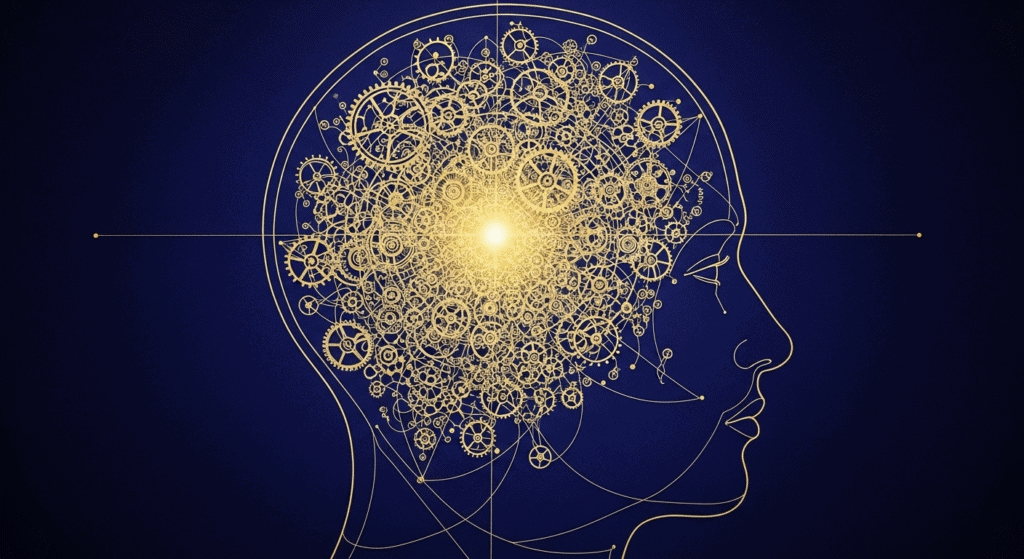
The other part of consciousness is everything that is not the “True Self.” As the “True Self” represents the “I,” all other consciousness is naturally the “Not-Self” Consciousness. This is a system built from countless programs, responsible for executing all detailed tasks and generating all information within our awareness. Our sensory information, emotions, feelings, and thoughts are all produced by the “Not-Self” Consciousness; they are, in essence, a part of it.
Psychology uses the term “subconscious” for mental activities we cannot perceive. The “Not-Self” Consciousness encompasses this, including all perceivable and imperceivable activities and their content. There is no essential difference between what is perceived and what is not. In reality, we perceive only a tiny fraction of our conscious content. The rest remains hidden for two reasons: our perceptual ability is too weak, or the information is too faint and overshadowed by stronger signals. With stronger perception and a calmer mind, you could access these deeper layers once thought to be the exclusive domain of the “subconscious.” As the vast majority of our consciousness is imperceptible, we can roughly equate the “Not-Self” with the traditional concept of the subconscious.
When we perceive an emotion, the subject doing the perceiving is the “True Self.” The emotion being perceived, along with all other content, belongs to or is produced by the “Not-Self.”
In addition to generating mental activity, the “Not-Self” also maintains the body’s physiological functions. Therefore, it exists not only in the brain but throughout the body. When the physiological systems of the “Not-Self” cease to function, the body dies. A healthy “Not-Self” leads to a healthy body; a poor state of consciousness often leads to physical ailments. This is why many people find that after practicing meditation, both their mental and physical health improve, even without physical exercise. As the state of consciousness is enhanced, the part of the “Not-Self” responsible for physiology also becomes healthier, repairing the body.
Why Meditation Works: The Underlying Principles
The “Not-Self” is a vast, spontaneously operating system with countless sub-programs running incessantly, typically quieting down only in deep sleep or meditation. It is complex and fast, but not efficient or orderly. It contains numerous useless, even harmful, programs that often conflict with one another—this is the root of the complex, contradictory nature of humanity. These harmful programs consume vast amounts of energy and cause a multitude of problems. When a person’s mental state is poor, listless, and depressive, it signifies that too many harmful programs are running rampant in their “Not-Self” Consciousness. The “Not-Self” can be changed and reshaped because its constituent sub-programs can be created, strengthened, weakened, and eliminated—this is the source of consciousness’s plasticity. We can solve problems by suppressing the activity of these harmful programs or even removing them entirely. Meditation works by leveraging this very principle.
Our “True Self” is fundamentally different from our “Not-Self.” It produces no specific actions. Our thoughts, emotions, feelings, and the motor commands that control our body do not originate from the “True Self.” Any action you can think of is not generated by it. However, the “True Self” can perceive actions and information, and it can think, analyze, and make decisions based on what it perceives. But since all actions are executed by the “Not-Self,” the “True Self” must control the “Not-Self” to carry out its cognitive functions.
We have two modes of thinking: “conscious thought” and “unconscious thought.” “Unconscious thought” is the fully automated thinking of the “Not-Self,” without the participation or perception of the “True Self.” We generate a massive amount of unconscious thought in response to sensory input. This process is fast but blind, as it is not directed toward a specific goal. Under its influence, we often make foolish and erroneous decisions.
“Conscious thought” is the process where the “True Self” participates, directing the “Not-Self” to analyze information and make decisions, usually to achieve a specific goal. If the “True Self’s” control is weak, this process is slow. For most people, conscious thought is far slower than unconscious thought because their “True Self” is generally too weak. A stronger “True Self” with greater control leads to faster conscious thought and quicker reactions.
The “True Self” is absolutely rational. All irrational motives—emotions, feelings, biased concepts—originate from the “Not-Self.” The “True Self” itself has no irrational drivers; its judgments are naturally rational. In reality, our decisions are a product of the interaction between both, with the “Not-Self” being overwhelmingly dominant. This is why human decisions are often irrational. When our state of consciousness is more dominated by the “True Self,” we become more rational—not in the sense of scientific or philosophical training, but a rationality free from the influence of emotions and dogmas, leading to greater peace and tolerance. A state dominated by the “Not-Self” leads to emotional volatility, stubbornness, and even extremism. Meditation shifts the balance of power toward the “True Self,” which is why long-term meditators become more rational, emotionally stable, and internally calm.
Taming the System: The Battle Between Two Selves
The “True Self” and “Not-Self” can influence and control each other. In theory, the “True Self” can control and reshape the “Not-Self.” In reality, the “True Self” in most people is too weak to control more than a tiny fraction of the “Not-Self.” We are almost completely dominated by the “Not-Self.” Still, we can use this limited influence to gradually change our state of consciousness for the better. Meditation is the practical application of this path, which is why it can resolve so many mental and emotional issues.
Likewise, the “Not-Self” also controls the “True Self.” Its programs constantly process information, generate feelings, and then apply a binary judgment of “good” or “bad.” For feelings judged as “bad,” it produces a reaction of resistance, compelling the “True Self” to avoid the source of that feeling. For feelings judged as “good,” it produces a reaction of affinity, compelling the “True Self” to seek more of it. Through this dualistic mechanism and the subsequent coercive identification, the “Not-Self” manipulates the “True Self,” suppressing and weakening it. This is why many meditation techniques advise practitioners not to differentiate between feelings. This distinction comes from the “Not-Self.” The instruction is a method to avoid its influence, to refuse to identify with the binary judgment, thereby weakening its power and diminishing its suppression of the “True Self.”
The Core Distinction: Why the “True Self” is the Master
Although both are called “consciousness,” the “True Self” and “Not-Self” are fundamentally different things. While the “Not-Self” appears vaster and more complex—producing our thoughts, feelings, and controlling our every move—the “True Self” is the absolute core. It is the root of our very existence. A person with only a “Not-Self” and no “True Self” would be in a permanent vegetative state—a walking corpse, a soulless shell.
With this understanding, we can answer any question about meditation. Meditation is a training method to improve the state of consciousness. The “wrong” state is to let the automated “Not-Self” system run your life; the “correct” state is to let the “True Self” dominate. Meditation repairs the state of consciousness by shifting the locus of control from the “Not-Self” to the “True Self,” allowing the real you to become the master.
The Practical Path: How to Truly Practice Meditation
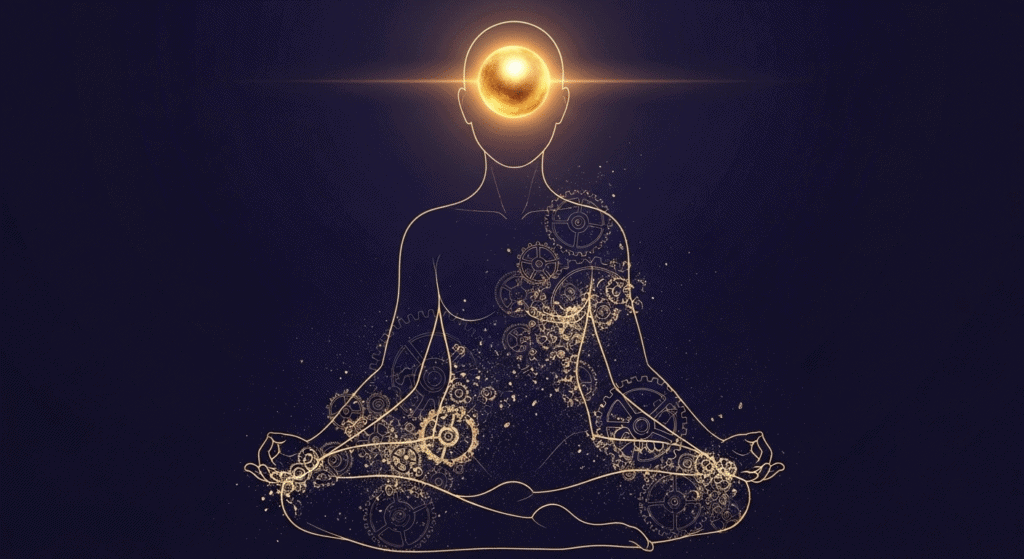
This improvement manifests in two ways. First, the “True Self” becomes stronger. You will feel your awareness become clearer and your perception stronger, both of internal activities and external events. Since attention and memory are founded on the “True Self,” you will notice a marked improvement in both. A stronger “True Self” also enhances your ability to withstand the impacts of the “Not-Self,” which is mainly observed as an increased tolerance for pain.
Second, the suppressive activities of the “Not-Self” are eliminated, which greatly reduces its overall activity level. As it becomes less active, the storm of uncontrolled thoughts and feelings in the mind subsides. This leads to a profound sense of calm and relaxation. Attention rests naturally on the present task or sensory input, rather than being swept away by uncontrolled thoughts and emotions—this is the state of “living in the present.”
There are many meditation methods, but any effective one must adhere to the laws of consciousness. The primary principle of meditation is to use the “True Self’s” control over the “Not-Self” to reduce its activity and eliminate its harmful programs. Most methods are designed based on a few simple applications of this principle.
First, meditation must be practiced while awake—the more awake, the better. A more awake state means a more active “True Self,” which translates to a stronger ability to transform consciousness and better results.
During meditation, one must consciously perceive something—the breath, a sensation, or an external object like a candle flame—but only perceive, without generating any associated thoughts. Most of our thoughts are initiated by the “Not-Self”; when you get caught up in them, you are being manipulated. Using conscious perception to suppress the “Not-Self’s” activity and still the mind is the core principle of most meditation techniques. The ability to stop the flow of thought demonstrates your mastery over it. This does not diminish your capacity for thinking; on the contrary, it enhances your control over the mind, making thought more effortless.
Some visualization techniques create thought activities, such as imagining yourself as a light feather to relax the body. The principle here is to tame the “Not-Self” by issuing commands it is less likely to resist. This is, in essence, a form of conscious self-hypnosis.
During practice, remain as unaffected as possible by the “Not-Self”—by its thoughts and feelings. When you notice your attention has been dragged away, gently bring it back to your object of focus. There is no need to feel frustrated or annoyed, because this frustration is also a manipulation by the “Not-Self.” When painful feelings arise, do not resist them. As spiritual masters often say, you must allow everything to happen, including things that cause you pain. Do not resist; be with them naturally. This may seem puzzling: why should we allow suffering? Shouldn’t we fight it? The reason is that the things that trigger your instinctive resistance—the so-called “bad” things—are merely tools defined by the “Not-Self” to manipulate you, and it does so precisely by making you resist them. When you cease to resist, the manipulation fails, the tool becomes useless, and the suffering dissipates. Therefore, letting go of resistance is the best way to eliminate pain.
Another special technique involves observing an object and then attempting to recreate its sensory image in the mind through imagination. This is also an effective method for strengthening the “True Self” and its control over the “Not-Self.” In short, once you understand the nature of consciousness, you can easily grasp the principles behind any of these training methods.
Beyond Well-being: The Ultimate Goal of Meditation
Today, many people practice meditation to improve their mental state. But its purpose extends far beyond simply making the body and mind healthier. Meditation originates from ancient India, where spiritual practitioners used it to achieve ultimate spiritual liberation. It can transform the state of consciousness to its absolute limit, a point where the “True Self” is completely free from the control of the “Not-Self” and achieves its full potential. This profound change in consciousness transforms a person into a “super-being,” completely different from ordinary people.
However, although many people practice meditation, very few ever discover this. They do not understand the nature of spirituality, and their practice remains at a very preliminary stage, resulting in only a limited transformation of their consciousness.
To understand the core paradox of the self mentioned in meditation, you can read my foundational essay:Are You the Ship of Theseus? An Inquiry into the Self
The Inquiry Continues… In the Book.
This essay explores a single facet of a much larger, interconnected system. It is the tip of the iceberg.
The full 449-page framework of my book, “The Secret of Consciousness,”*reveals the entire structure beneath—the foundational principles that connect all these ideas into a single, cohesive whole. If you are ready to see the complete picture, your journey starts here.
Pingback: The Nature of Consciousness: A First-Principles Model