
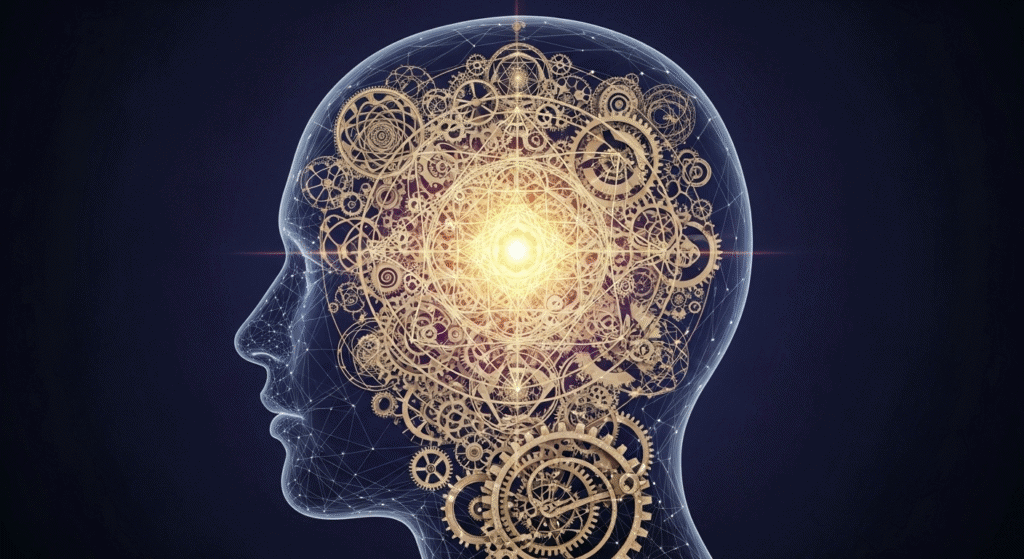
The development of the natural sciences has primarily focused on exploring the external world, yet our understanding of ourselves, especially at the level of consciousness, remains limited.
This article will attempt to analyze the nature of consciousness and its operational mechanisms, presenting what is likely the closest approximation to the truth thus far. This model can explain various phenomena in human society, including numerous physical and psychological problems. It can also explain the results of various experiments related to consciousness. You can even use this model to predict unknown phenomena and experimental outcomes; many conclusions that would typically require extensive experimental research can be easily deduced from this model. Furthermore, it effectively explains ancient spiritual theories and doctrines, including the principles by which meditation training can improve one’s state of consciousness.
The Foundational Axioms: Redefining the “I”
To understand this model of consciousness, one must first grasp its core foundation, which is a simple and plain piece of common sense:
If something is “I,” then I must have 100% knowledge of it.
If something is “I,” then I must have 100% control over it.
When we start from this common-sense basis to observe and think about our consciousness, a problem emerges: there is too much that is unknown within our consciousness. Although we often define consciousness as ourselves, our understanding of it is very limited, and we are far from being able to control its operations. We cannot even consistently control a single thought. This implies that a large part of the content of our consciousness is not the true “I.”
When we discuss “my emotions” or “my feelings,” we linguistically describe them as “mine,” not as “me”—as something belonging to me. But in reality, we treat them as if they are us or a part of us. This intuitive and experiential judgment is incorrect; it is an illusion caused by the influence they have over us.
The Two-Part System: Deconstructing the Nature of Consciousness
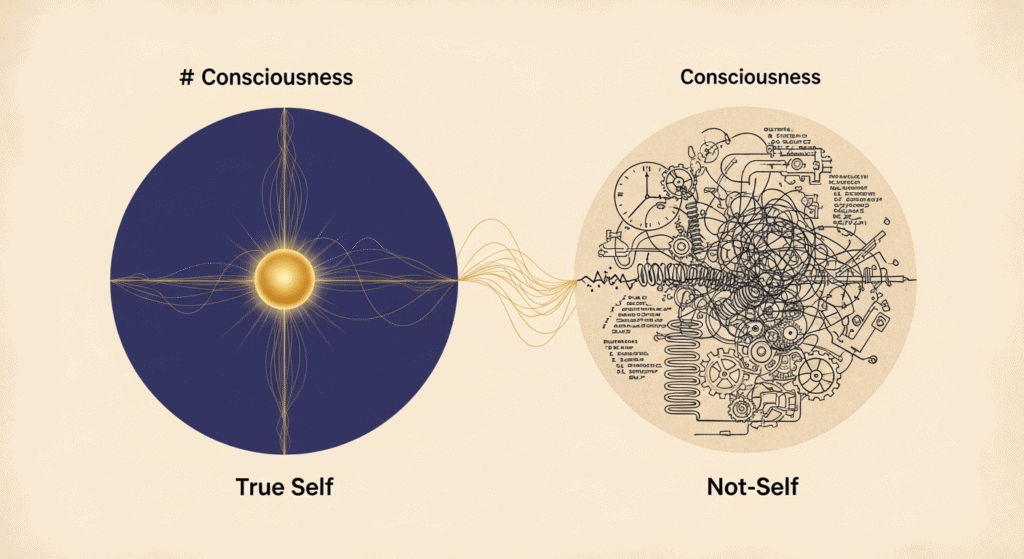
Our consciousness is not a monolithic whole but is composed of two entirely different parts: one is a single, unified individual, and the other is a system constructed from countless programs. The single individual is our “True Self” Consciousness, the real “I,” the foundation of our existence, and the source of what many religions and spiritual theories refer to as spirituality. We can be aware of our own existence precisely because this consciousness exists. When it becomes dormant, as in sleep or a coma, we lose our self-awareness. The other part of consciousness is the “Not-Self” Consciousness, a system built from countless programs responsible for executing all detailed tasks. In psychology, the concept of the subconscious refers to those conscious activities and contents that we cannot perceive. The “Not-Self” Consciousness includes the subconscious, as it encompasses all perceivable and imperceivable conscious activities and everything they produce. When we perceive our emotions, the subject doing the perceiving is the “True Self,” and the perceived emotions, along with all other content, belong to the “Not-Self.”
The “True Self” Consciousness: The Silent Perceiver
The “True Self” Consciousness has several key characteristics.
It Produces No Specific Actions.
The “True Self” does not generate any specific behaviors. From our experience, it seems “I” can perform many actions: I can breathe, speak, walk, and perform various movements. However, when we delve into the details of these actions, we find that “I” have never truly produced them. A simple act of speaking requires the precise coordination of multiple muscles, yet we never consider which muscles to control when we speak; sometimes, we are not even aware of what we have said.
A common misconception is that when we think, it is the true “I” that is thinking. In reality, you are merely perceiving a part of the thought activity and have some indirect control over it, which leads to the illusion that you are the one producing the thought. A simple phenomenon proves that thoughts are not generated by the true “I”: in most cases, we can hardly control our own thoughts. When you consciously cease to create any thoughts, your mind still ceaselessly produces various notions.
The real “I,” our “True Self,” does not produce any actions. The various behaviors we believe are produced by us are actually generated by the “Not-Self” Consciousness. Some of these are produced under the control of the “True Self,” but the executor of all actions is the “Not-Self.” The control of the “True Self” over the “Not-Self” is not a specific type of action.
It Produces No Information.
Just as it produces no specific actions, the “True Self” also produces no information. All information in consciousness is generated by the “Not-Self.” We can more easily understand that our feelings and emotions are not produced by the true “I,” as they are not consciously created by us but arise from instinctive reactions beyond our perception, which are then perceived by the “True Self.”
A common point of confusion is the belief that information generated during conscious thought is produced by the true “I.” This is not the case. It is merely that in conscious thought, the “True Self” has a certain degree of participation, perceiving the entire process in real-time, which creates the illusion of having generated the information. Although the “True Self” does not produce information, it can perceive it, because it is the subject of all perception.
The “True Self” is Purely Rational, the Source of Human Rationality.
The “True Self” is the source of human sanity; it is naturally and purely rational. In reality, most people have both a rational and an emotional side. The emotional side of humanity comes from feelings, emotions, desires, aversions, and the identification with certain ideas—all of which originate from the “Not-Self,” not the “True Self.” The “True Self” contains nothing that causes emotionality; it is the very source of rationality. It is absolutely, purely rational.
Although the human “True Self” is absolutely rational, in reality, most people manifest a state mixed with emotionality and rationality. This is because the various irrational decision-making behaviors of the “Not-Self” influence the “True Self,” leading to the expression of an emotional side. The greater this influence, the more emotional one becomes, and in extreme cases, one may even lose all reason. As humans are heavily influenced by the “Not-Self,” they generally tend towards an emotional state.
Human rationality manifests in two forms. One is an intellectual rationality built upon an understanding of common sense, logic, and an acceptance of facts. This intellectual rationality is used to counteract the emotional factors within the “Not-Self.” The other is a spiritual rationality that comes from the strength of the “True Self.”
The “Not-Self” Consciousness: The Automated Program
In psychology, the concept of the subconscious refers to the content deep within consciousness that cannot be perceived, including thoughts, emotions, feelings, and so on. The reason this content is imperceptible is not due to any special attribute that makes it so, but because our perceptual ability is limited, capable of perceiving only the stronger and more obvious information in consciousness. There is no essential difference between the perceivable and imperceptible content of consciousness.
The “Not-Self” Consciousness refers to all consciousness other than the “True Self.” It includes all perceivable and imperceptible content in consciousness, including sensory information.
The “Not-Self” is an extremely vast and complex system, a collection of multiple subsystems composed of countless sub-programs, including the sensory system, information processing system, motor control system, and the physiological and immune systems. In medicine, the focus has always been on solving health problems at the material level, but the state of consciousness has a very significant impact on physical health because consciousness is the body’s operating system. The part of consciousness that maintains physiological activity and the immune system is relatively fixed, but it can sometimes undergo changes that manifest at the physiological level. For example, a person in a prolonged negative emotional state is more likely to fall ill; strong emotional fluctuations can produce obvious physiological reactions; the placebo effect; and methods like acupuncture, massage, or yoga and meditation can be used to heal diseases. These are all examples of changes at the conscious level affecting the physiological level.
Apart from some fatal external injuries, almost all diseases can be rapidly cured by repairing the state of consciousness. However, the consciousness that controls the physiological level is at the deepest layer of the “Not-Self,” is difficult to directly intervene in and modify, and is extremely complex; you can hardly even understand its specific operational methods. Therefore, healing the body by modifying consciousness still has significant limitations at present.
The programs constituting the “Not-Self” are hierarchical. Some are flexible and can be relatively easily controlled by the “True Self”; our surface-level thought activities belong to this type. There are also semi-fixed programs that can, through a certain amount of training, form fixed patterns and operate autonomously, while also allowing for some adjustment during the process. For example, our language, skills, habits, and conceptual frameworks belong to this type. There are also programs akin to fixed code, whose operation is determined by specific encoding to achieve specific tasks, such as the sensory system, and the physiological and immune systems. These are more difficult to change.
The “Not-Self” Consciousness can be viewed as a general-purpose artificial intelligence system that very closely imitates humans. Although the general AI system you might imagine may differ somewhat from the human “Not-Self” in reality, their principles are the same. In recent years, as AI has developed rapidly and become more and more human-like, some people worry that AI might awaken, possess independent consciousness, and thereby harm humanity. This worry is unnecessary. For AI to awaken like a human, it would need to possess a “True Self” Consciousness. But the “True Self” cannot be born spontaneously from a complex “Not-Self” system, because the two are fundamentally different things, revealing the profound nature of consciousness.
The Operating Principles: How the System Runs
The Concurrency of the “Not-Self”
The “Not-Self” can operate concurrently. This concurrency does not just refer to multiple systems working simultaneously, but even within the same system, multiple programs can run at the same time. Therefore, the “Not-Self” can perform multiple tasks simultaneously. In reality, this is manifested in the fact that maintaining our basic physiological activities requires the completion of a vast number of tasks at the same time, and we can also do multiple things at once. However, when faced with tasks that require attention, we can often only perform one task at a time. This is because these tasks require the participation of the “True Self,” which is a single entity and does not have concurrent capabilities. However, if the “True Self” is sufficiently powerful, it can switch rapidly between two or even multiple tasks, making it appear to have some concurrent ability.
In this respect, the “True Self” is akin to a single-core CPU in a computer, while the “Not-Self” is like a GPU.
The Redundancy and Conflict of Programs in the “Not-Self”
There are countless programs in the “Not-Self.” Apart from maintaining basic physiological and information processing tasks, there are also a large number of redundant programs. These redundant programs have two disadvantages: one is that they cause unnecessary energy consumption, and the other is that they bring many harms, suppressing the “True Self,” making it weak, causing cognitive impairments, and damaging physical and mental health, among other problems. In the process of information processing, the numerous programs in the “Not-Self” will produce different judgments about a certain thing, causing conflict. This conflict is widespread. Many spiritual theories and doctrines teach people to eliminate these redundant and harmful programs in the “Not-Self” to return to their own “True Self,” which is a core aspect of understanding the nature of consciousness.
The Plasticity of the “Not-Self”
The “Not-Self” is composed of various programs that can be changed, created, or eliminated. Therefore, the “Not-Self” is plastic.
There are two ways to change the “Not-Self.” One is through the influence of information input. When the “Not-Self” receives and processes information, it not only outputs a certain result but may also undergo some changes itself; certain programs may be created, eliminated, or altered. When a person is exposed to a certain type of information for a long time, their ideological concepts will be changed. This change stems from the modification of the decision-making programs in the “Not-Self,” which is the fundamental reason why humans can be brainwashed by information. The environmental information mentioned here includes not only information that can be described by language and thought but also all the indescribable environmental information received through the senses, including the impact of the food we eat and the information generated by the physical body. Much of this information is ignored by human perception. The influence of environmental information on the shaping of the “Not-Self” is very broad and deep, and can even penetrate to the underlying consciousness that controls physiological activities. But most environmental information has a negative impact on consciousness, and the current information-saturated social environment exacerbates this problem.
In addition to sensory information, memory information also has a formative effect on the “Not-Self.” The actual information stored in our memory may be far more extensive than what we can recall.
Another way to shape the “Not-Self” is to use the influence of the “True Self” to shape it. The effect of this form of shaping tends to eliminate the redundant and harmful programs in the “Not-Self,” so the modification of the “Not-Self” by the “True Self” is often positive. The principle behind spiritual training methods like meditation is to use the power of the “True Self” to positively shape the “Not-Self,” strengthening the “True Self” while eliminating the harmful programs within the “Not-Self.”This practical application is key to grasping the nature of consciousness.
The Mutual Influence and Control Between “True Self” and “Not-Self”
The “True Self” and “Not-Self” influence each other. Many programs in the “Not-Self” exert influence on the “True Self,” attempting to manipulate it to realize the decision-making behaviors produced by the programs. This influence suppresses the “True Self,” making it weaker.
The “True Self” can also influence and change the “Not-Self.” It can strengthen or weaken a certain program, or generate or eliminate one, thereby shaping the “Not-Self.” When you consciously repeat a certain behavior, a program for executing this behavior will be formed or strengthened in the “Not-Self,” which manifests externally as the formation of a habit or skill.
When you consciously perceive the various activities in the “Not-Self,” its influence on the “True Self” becomes clearer and stronger. If, during this process, you strive not to be influenced by the “Not-Self,” the programs that influence the “True Self” will be weakened or even eliminated because they cannot achieve their intended goal. Many meditation practices shape the “Not-Self” through this principle, weakening and reducing the programs that suppress the “True Self” and strengthening the “True Self.” Therefore, after a period of training, practitioners will feel that their consciousness is clearer, more focused, and more relaxed.
Practical Applications: Explaining the Human Condition
The Locations of “True Self” and “Not-Self” in the Body.
Combining modern scientific research on the brain with clues from ancient spiritual teachings, a definite conclusion can be drawn: the “True Self” is located in the prefrontal cortex of our brain. Relevant scientific research shows that the prefrontal cortex area is not responsible for any specific function but can control and regulate various areas of the brain. These characteristics are completely consistent with those of the “True Self.” In some spiritual theories, the forehead area is described as the source of the spirit, which is precisely where the prefrontal cortex is located.
The “Not-Self” is located in other parts of the brain and throughout our body. Because the “Not-Self” includes the entire sensory system and is also responsible for maintaining the entire body’s operation, it must be distributed throughout the body.
The Influence of Consciousness on Gene Expression.
Although human gene sequences are fixed, gene expression is variable. Consciousness can influence and even determine gene expression. If not for unexpected factors, we should have no difficulty finding evidence in related experiments. If the factor of consciousness is not taken into account when explaining how genes are expressed, and inferences are made based solely on the physical properties of matter, many phenomena related to the nature of consciousness will be difficult to explain.
The Issue of Attention.
The “True Self” is the subject that achieves attention; it is what is paying attention to something. Therefore, in a state of sleep or coma, we have no attentive behavior, because the “True Self” is dormant. When we are more awake, that is, when our source is stronger, our attention will be stronger.
The “Not-Self” constantly transmits a massive amount of information to the “True Self.” The “True Self” cannot perceive all of it; generally, it can only notice a very small amount of the stronger information.
A massive amount of information is constantly being generated in consciousness. This information has different weights that determine whether it can be perceived. The weight of sensory information is relatively fixed, while many pieces of information with highly variable weights, such as thoughts, emotions, and feelings, are produced during conscious activity. How this information is generated is determined by the state of the “Not-Self.”
Because the “Not-Self” is an extremely vast and complex system, it faces the problem of order and disorder. The first core principle of the “Not-Self’s” operation is to increase its own orderliness. To this end, when the “Not-Self” is in a disordered state, it first produces the emotion of boredom, and then a rejection of boredom. Through this rejection, a force is formed in consciousness that seeks information stimulation, which is the source of human curiosity.
The “Not-Self” will produce reactions of tension or excitement when processing certain information, increasing orderliness to a certain extent, reducing the feeling of boredom, and also to some extent, shielding the perception of boredom. However, when the “Not-Self” is in a state of tension or excitement for a long time, it becomes more active and more disordered, and will more easily feel bored, thus requiring stronger information stimulation to escape boredom, easily falling into a negative cycle. Therefore, people who long pursue desires and strong stimuli will more easily feel bored in simple daily life.
When the “Not-Self” processes information, it produces a corresponding feeling, which is then distinguished in a binary mode into pleasant and painful types. When a feeling is identified as pleasant, a desire for the pleasant feeling is produced. Since feelings cannot be directly acquired but are the product of information processing, this manifests externally as the pursuit of things that can produce pleasant feelings.
If a feeling is distinguished as a painful feeling, a resistance reaction will be produced, forcing a person to stay away from the information source that can produce the painful feeling. This manifests externally as a person avoiding things that cause them to feel pain.
Pleasant or painful feelings can be produced by external environmental information stimulation, or by the internal state of consciousness. If a person’s state of consciousness is relatively good, they will easily produce pleasant feelings. If a person’s state of consciousness is poor, they will easily produce painful feelings.
As the producer of information, the “Not-Self” can largely determine what you should pay attention to. The first choice of the “Not-Self” is information that is conducive to increasing its own orderliness, and then on this basis, it prioritizes information that can produce pleasant feelings. If it cannot find information stimulation that can produce pleasant feelings, it will turn to seeking painful feeling stimulation. Externally, people often seek information stimulation that can produce pleasant feelings. If they cannot find it, they will seek painful stimulation or create pain. This is the attention mode dominated by the “Not-Self.”
Besides the “Not-Self,” the “True Self,” which is you yourself, can also decide what you pay attention to. The “True Self” is the perceiving subject of information and also the realizing subject of attentive behavior. We can use the “True Self’s” ability to influence and control the “Not-Self” to decide our object of focus. When you consciously perceive and control the “Not-Self” to perform certain actions, you are in a state of focus that tends to be dominated by the “True Self.”
This form of focus is usually manifested in focusing on things that are valuable but not of strong interest. The state of focus during learning or work generally belongs to this type, except when one is very interested in the content of the learning or work.
This focus mode requires a certain ability to control the “Not-Self.” Therefore, the “True Self” needs to be sufficiently powerful, which means that if the prefrontal cortex is not well-developed, it will be difficult to control your attention. And the “Not-Self” cannot be overly active, which means that when the brain is overly tense or excited, the difficulty of controlling attention will significantly increase, unless the object of excitement happens to be the object that needs to be focused on.
When we say that a person has good concentration, we usually mean that their focus mode is one that tends to be dominated by the “True Self,” because the focus mode dominated by the “Not-Self” is controlled by desires and interests, not by autonomous will; the direction of focus is uncontrollable and unstable. This distinction is fundamental to the nature of consciousness.
The Issues of ADHD and Depression.
There is a symptom related to attention called ADHD, Attention-Deficit/Hyperactivity Disorder. The core manifestation of this symptom is that the patient has difficulty controlling their attention.
The fundamental reason for ADHD symptoms is that the “Not-Self” of ADHD patients is more active than that of most people. Therefore, the “True Self” finds it more difficult to control, and thus, they are weaker in terms of conscious focus than ordinary people. Their focus mode tends to be dominated by the “Not-Self.” Mainstream medicine believes that the root cause of ADHD symptoms lies in a functional deficit of the prefrontal cortex. This statement is reasonable; compared to ordinary people, the power of their “True Self” relative to their “Not-Self” is weaker.
Due to the more active “Not-Self,” which is more prone to falling into a disordered state, ADHD patients will feel bored more easily than ordinary people, which is why they are more hyperactive and have stronger curiosity. They need to constantly find interesting things for the “Not-Self” to process to improve its orderliness and reduce the feeling of boredom.
The “Not-Self” is responsible for all information processing. A more active “Not-Self” means stronger information processing capabilities. Therefore, many ADHD patients will appear smarter than ordinary people, especially in childhood, and they can easily show strong talent in their areas of interest. If those talents are well developed, they can easily achieve great success. Many historical figures have shown symptoms of ADHD.
But at the same time, because of the attention control problems of ADHD, their talents may not be well developed and maintained, so that their achievements in later life are not high.
According to theoretical deduction, ADHD patients are more likely to suffer from depression than ordinary people, because the negative thoughts and feelings that trouble depressed patients come from the “Not-Self.” A more active and more easily out-of-control “Not-Self” is very likely to produce strong and negative thoughts and emotions, plunging people into deep suffering. This insight into the nature of consciousness helps explain the comorbidity.
In related research, it can be clearly found that people with ADHD symptoms have a higher proportion of depression, and depressed patients also have common ADHD symptoms. The only difference is that depressed patients find it difficult to develop an interest in things, which is a manifestation of the “Not-Self” being unable to maintain its own orderliness and falling into chaos.
Theoretically, meditation practice can solve the problems of ADHD and depression. But in practice, it may not achieve universal effects, because the state of consciousness of ADHD and depressed patients determines that the difficulty of practicing meditation for them is much higher than for ordinary people. Meditation is a very difficult exercise for them to complete, which leads to poor practical effects. Understanding this difficulty is crucial when considering the nature of consciousness in clinical contexts.
To explore how these principles of consciousness apply to transformative practices, read my in-depth guide: The Truth About Meditation That No One Tells You.
The Inquiry Continues… In the Book.
This essay explores a single facet of a much larger, interconnected system. It is the tip of the iceberg.
The full 449-page framework of my book, “The Secret of Consciousness,”*reveals the entire structure beneath—the foundational principles that connect all these ideas into a single, cohesive whole. If you are ready to see the complete picture, your journey starts here.